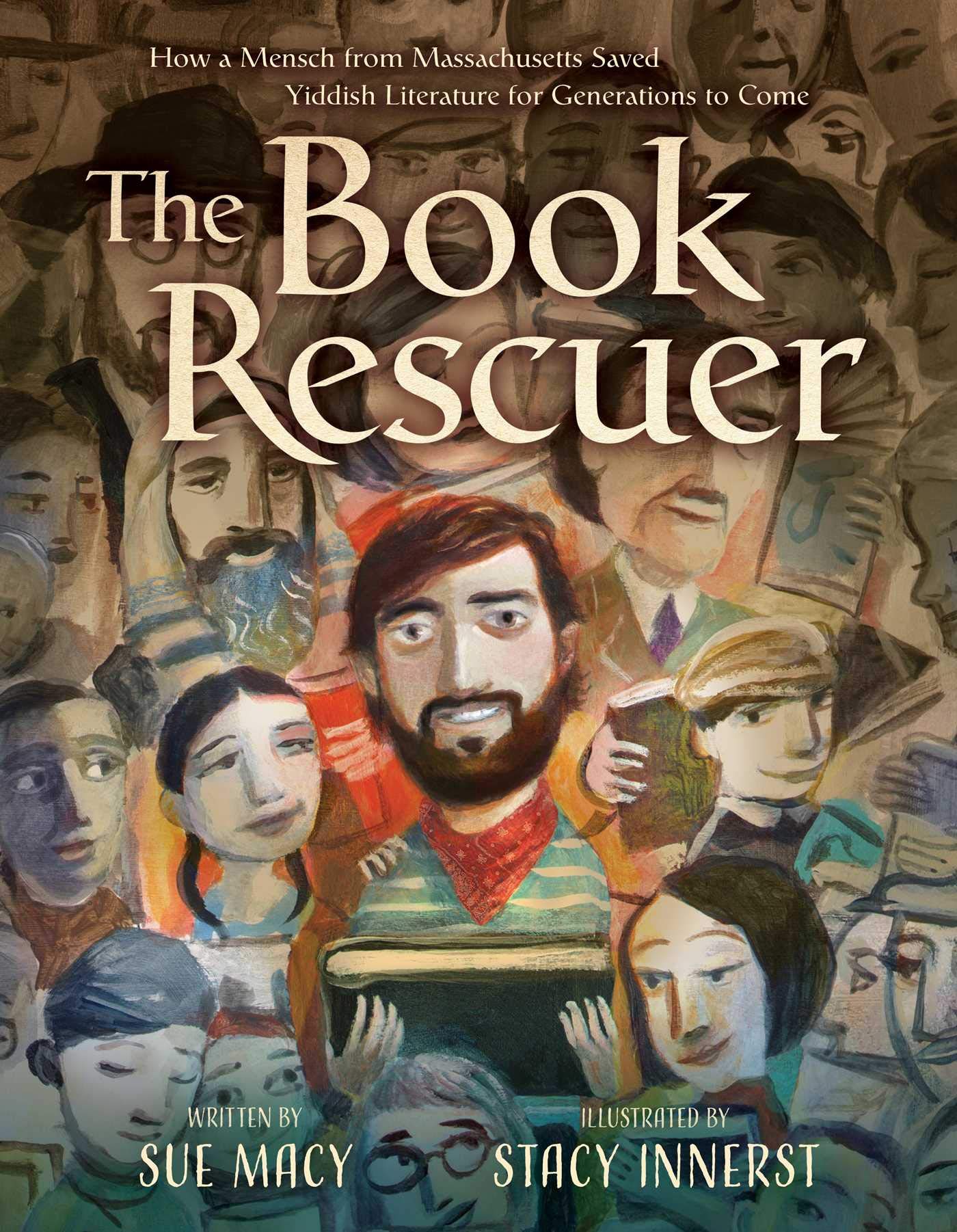
The Book Rescuer: How a Mensch from Massachusetts Saved Yiddish Literature for Generations to Come by Sue Macy, illustrated by Stacy Innerst

Published by Simon and Schuster/Paula Wiseman Books

Image result for book rescuer sue macy

Image result for book rescuer sue macy

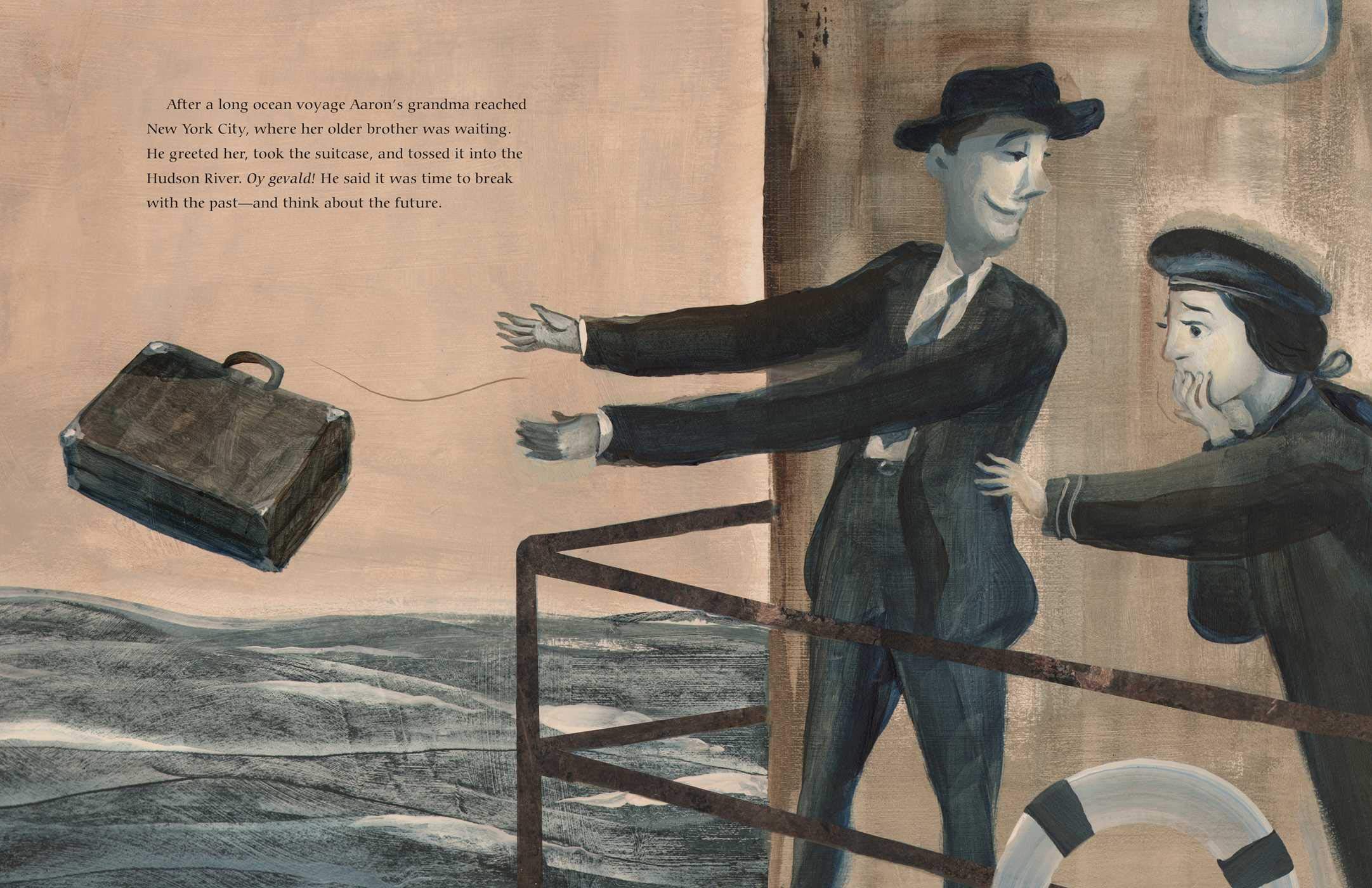
Summary:  When Aaron Lansky was growing up, he heard the story of his grandmother, who immigrated to America when she was 16.  Her older brother greeted her by throwing her suitcase into the Hudson River, telling her it was time to break with the past.  Aaron has spent his adult life working tirelessly to find and preserve that past. As a college student interested in learning Jewish history through Yiddish novels, he discovered a passion for Yiddish books, and began traveling around the country to rescue them.  In 1980, he founded the Yiddish Book Center in Amherst, Massachusetts. A MacArthur grant in 1989 recognized his work, which he continues today, having collected 1.5 million books in Yiddish that he shares with people all over the world. Includes an afterword by Aaron Lansky, an author’s note, illustrator’s note, glossary of yiddish words, and a couple sources of additional information.  48 pages; grades 1-5.

Pros:  What could have been a dry, uninteresting topic comes to life in Sue Macy’s capable hands, aided by the Marc Chagall-inspired artwork.  The back matter fleshes out the story even further, and includes information for visiting the Yiddish Book Center, which turns out to be less than 30 miles from my house.

Cons:  I started to feel some pangs of guilt about my enthusiasm for weeding my libraries.

If you would like to buy this book on Amazon, click here.

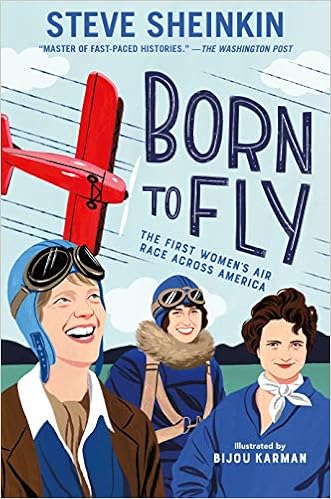
Born to Fly: The First Women’s Air Race Across America by Steve Sheinkin, illustrated by Bijou Karmans

Published by Roaring Brook Press

Image result for born to fly sheinkin

Summary:  In 1929, women pilots competed in the Air Derby, the first all-female cross-country race, to see who could be the first to fly from Santa Monica, California to Cleveland, Ohio.  The most famous was Amelia Earhart, but all the women had broken multiple barriers to learn how to fly, and many held records for speed, height, endurance, and long-distance flights.  Starting with a childhood frequently spent jumping off roofs or other high places, Steve Sheinkin traces how each of the women got to the race, then follows the pilots on their nine-day journey.  There were suspicions of sabotage as planes were wrecked and one pilot died, but all the women were determined to see it through. “They started by jumping off roofs. They wound up kicking down doors–for themselves, and everyone else.”  Includes extensive source notes, works cited, and index. 288 pages (60 pages is notes, citations, and index); grades 5-8.

Pros:  Steve Sheinkin does it again, writing a nonfiction book that reads like a novel.  I wasn’t all that excited about starting this book, but once I did, I couldn’t put it down.  Readers will learn that there were many women–not just Amelia Earhart–who defied the social norms to follow their passion for flying.  Lots of illustrations and photos enhance the text.

Cons:  There were so many different pilots to keep track of, some with the same first name, that I sometimes had trouble keeping everyone straight.

If you would like to buy this book on Amazon, click here.

Image result for air derby 1929

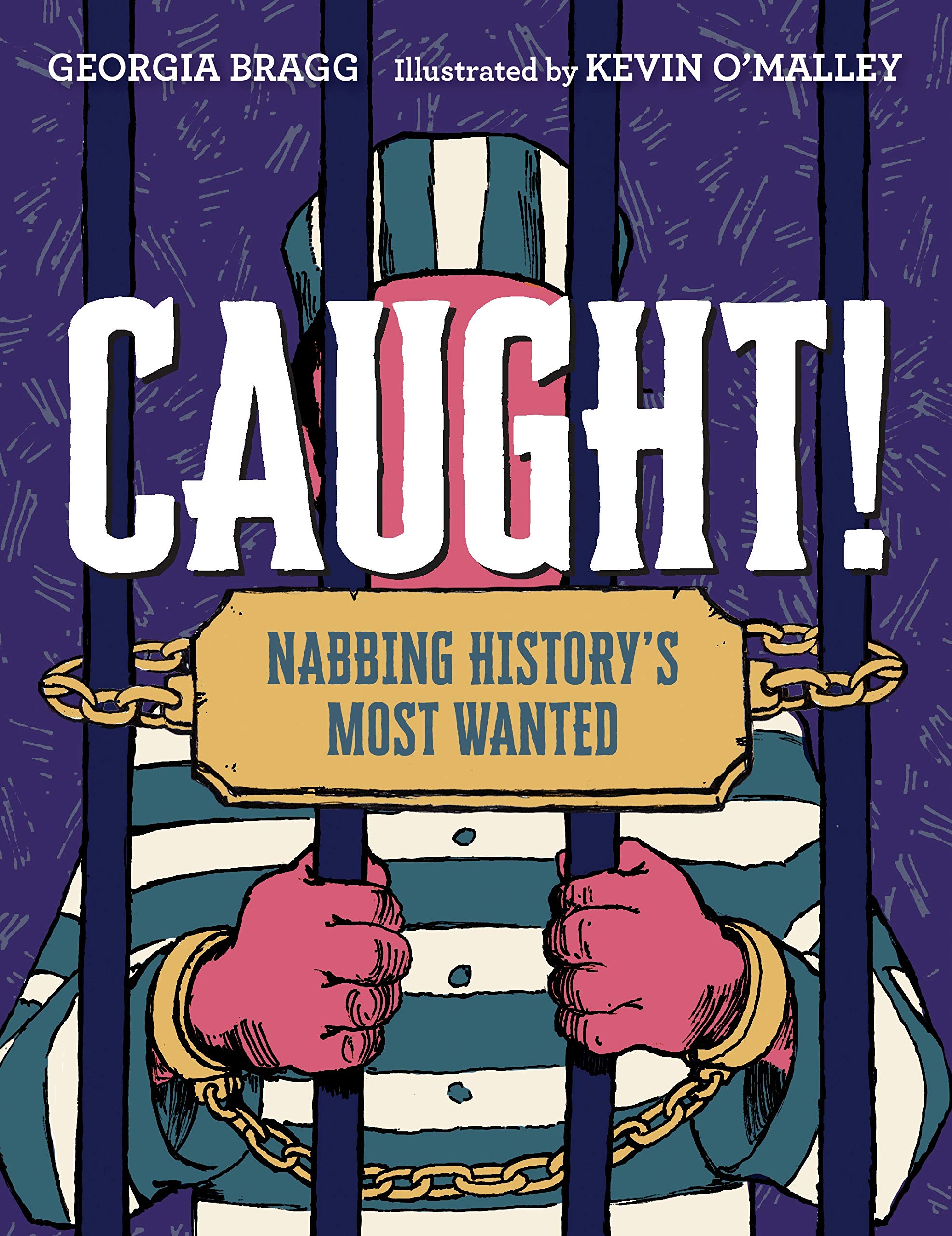
Caught! Nabbing History’s Most Wanted by Georgia Bragg, illustrated by Kevin O’Malley

Published by Crown Books for Young Readers

Image result for caught nabbing history's most wanted

Summary:  From the team that brought you How They Croaked: The Awful Ends of the Awfully Famous and How They Choked: Failures, Flops, and Flaws of the Awfully Famous comes this collection of 14 profiles of interesting criminals.  Some will be known by just about everyone (John Wilkes Booth, Joan of Arc), while others are less famous…or infamous (Vincenzo Peruggia, Bernard Otto Kuehn).  Each profile is several pages long, with two additional pages of “Facts and Stats”. Black and white illustrations throughout match the humorous, irreverent tone of the text.  Includes separate bibliographies of print and online sources for each person as well as an index. 224 pages; grades 4-8.

Pros:  History buffs and reluctant readers alike will enjoy these funny, breezy profiles of notorious criminals from all ages.  The author does a good job of adding some historical context which often makes the dastardly deeds a bit more understandable.  The extensive back matter could lead to a lot more research on any one of them.

Cons:  The most recent subject is Al Capone, born in 1899.  We can hope that a sequel is in the works for more recent criminals.  

If you would like to buy this book on Amazon, click here.

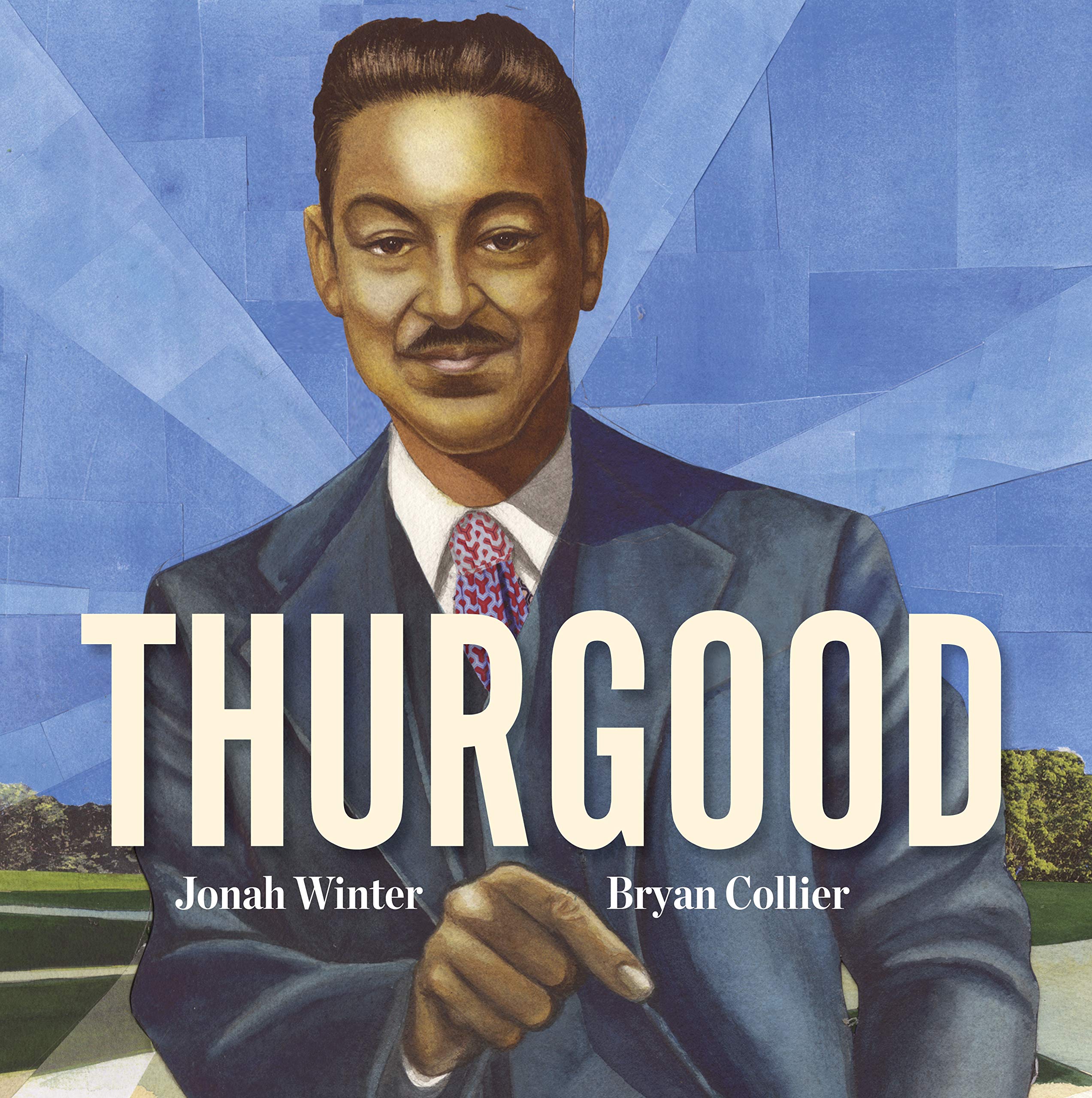
Thurgood by Jonah Winter, illustrated by Bryan Collier

Published by Schwartz and Wade

Image result for thurgood jonah winter

Image result for thurgood jonah winter

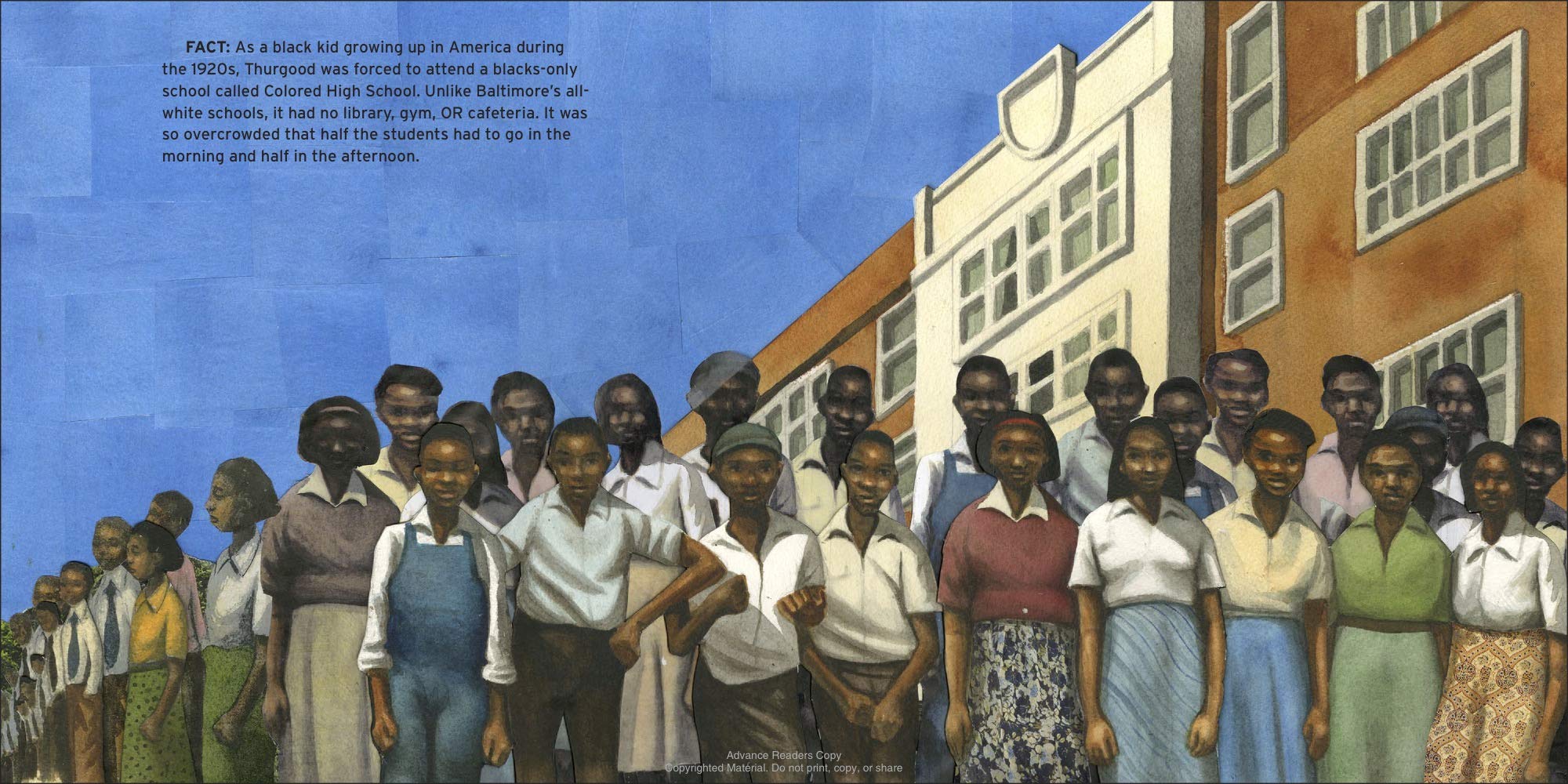
Summary:  Thurgood Marshall’s path to legal greatness began at the age of six, when he convinced his parents to legally change his name from Thoroughgood to Thurgood.  Growing up in 1920’s Baltimore, he saw injustice on a daily basis; at home, he learned from his father to back up his statements with factual evidence. After leading his high school debate team, Thurgood went on to college and then to law school at Howard University.  He became a lawyer for the NAACP, and argued 29 cases before the Supreme Court, including Brown v. Board of Education.  The book ends with that decision, simply mentioning on the last page that Marshall became the first black Supreme Court justice in U.S. history.  Includes an author’s note with more information about Thurgood Marshall’s Supreme Court appointment and career. 40 pages; grades 1-5.

Pros:  A powerful narrative about Thurgood Marshall’s life, presenting much of the information in legal terms (“Fact:”; “Verdict:”; “Injustice:”).  Bryan Collier’s illustrations boldly bring to life many dramatic scenes from Marshall’s life, in the courtroom and in unjust, sometimes dangerous settings growing up in Baltimore and traveling through the South.  

Cons:  The author’s note states, “A forty-page picture book such as this cannot possibly convey the magnitude of his legacy”, yet there are no resources for additional research.

If you would like to buy this book on Amazon, click here.

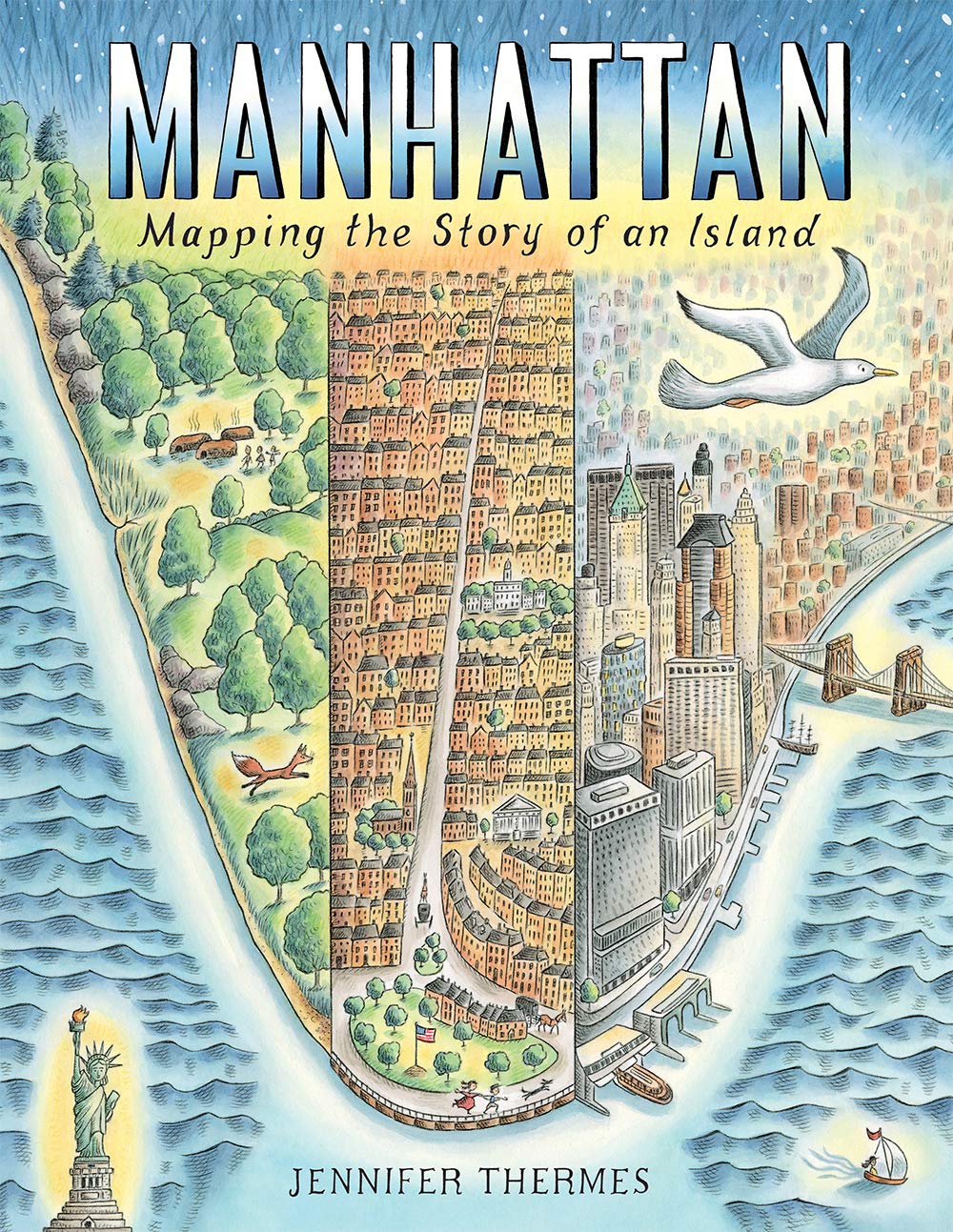
Manhattan: Mapping the Story of an Island by Jennifer Thermes

Published by Harry N. Abrams

Image result for manhattan jennifer thermes

Image result for manhattan jennifer thermes

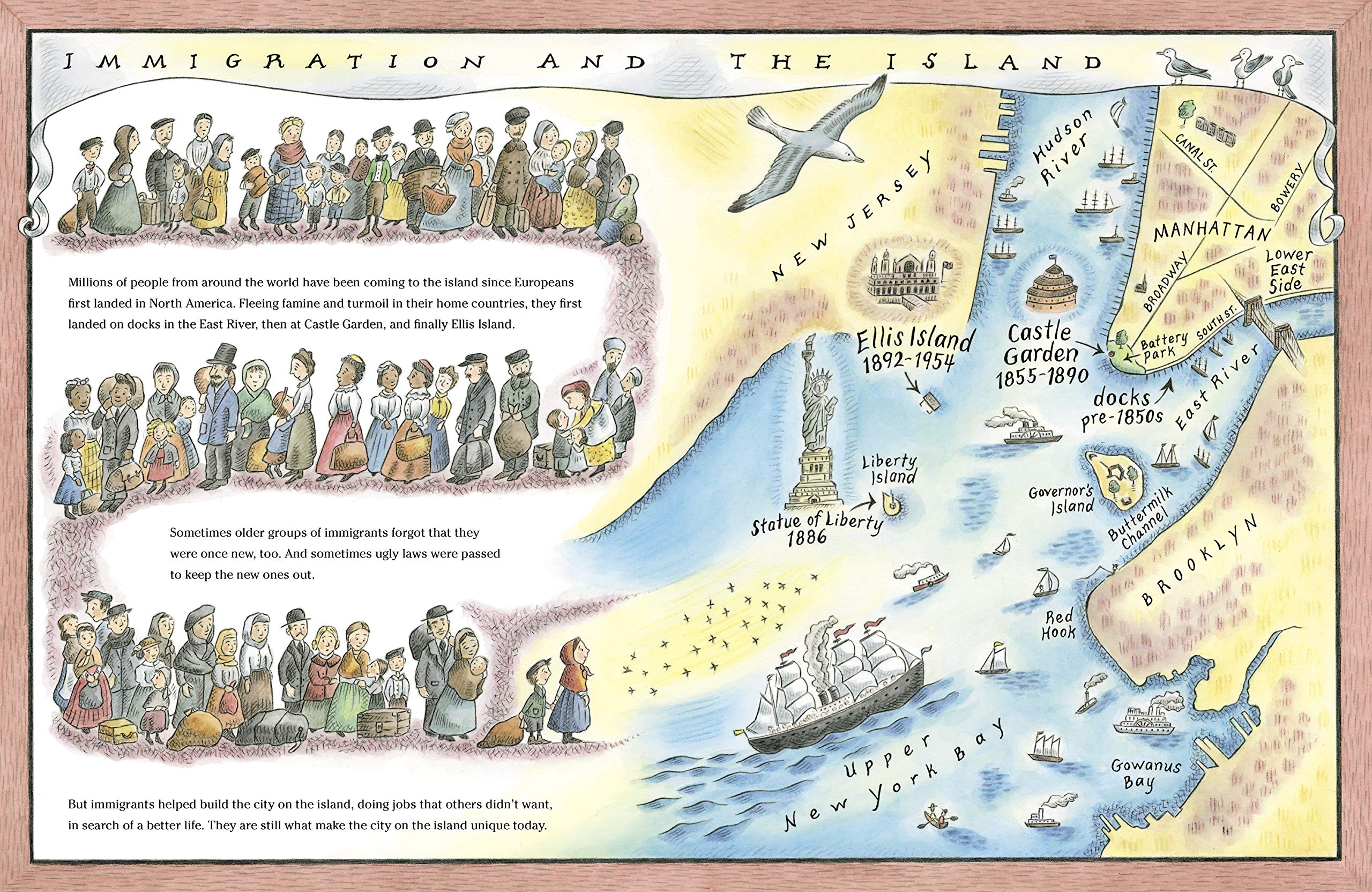
Summary:  From Henry Hudson’s discovery in 1609 to Hurricane Sandy in 2012, this history looks at the changes made to the island of Manhattan.  Before the arrival of the Europeans, the island was inhabited by the Lenape who called it Mannahatta, meaning “islands of many hills”.  That landscape changed in the early 19th century, when city planners created a grid of roads that flattened hills and straightened curves.  When life in the grid became too congested, Central Park was created to bring some green space to the city. Blizzards, fires, skyscrapers, and bridges have all changed the look of the city over the years, and with close to 4 million people living or working in New York City every week, you can be sure that those changes will continue.  Includes an afterword; an extensive timeline crammed onto a single page; and a list of books, websites, and museums with more information. 64 pages; grades 3-7.

Pros:  As she did in Grandma Gatewood Hikes the Appalachian Trail, Jennifer Thermes has created a picture book featuring beautiful maps that show a changing landscape.  There are plenty of other interesting illustrations as well, but the maps of Manhattan, all with the same shape, but gradually evolving over time, really tell the story of the city’s history.  Plan on putting aside a substantial chunk of time to enjoy this book in its entirety.

Cons:  I was surprised there was no mention of 9/11, except as an entry in the timeline.

If you would like to buy this book on Amazon, click here.

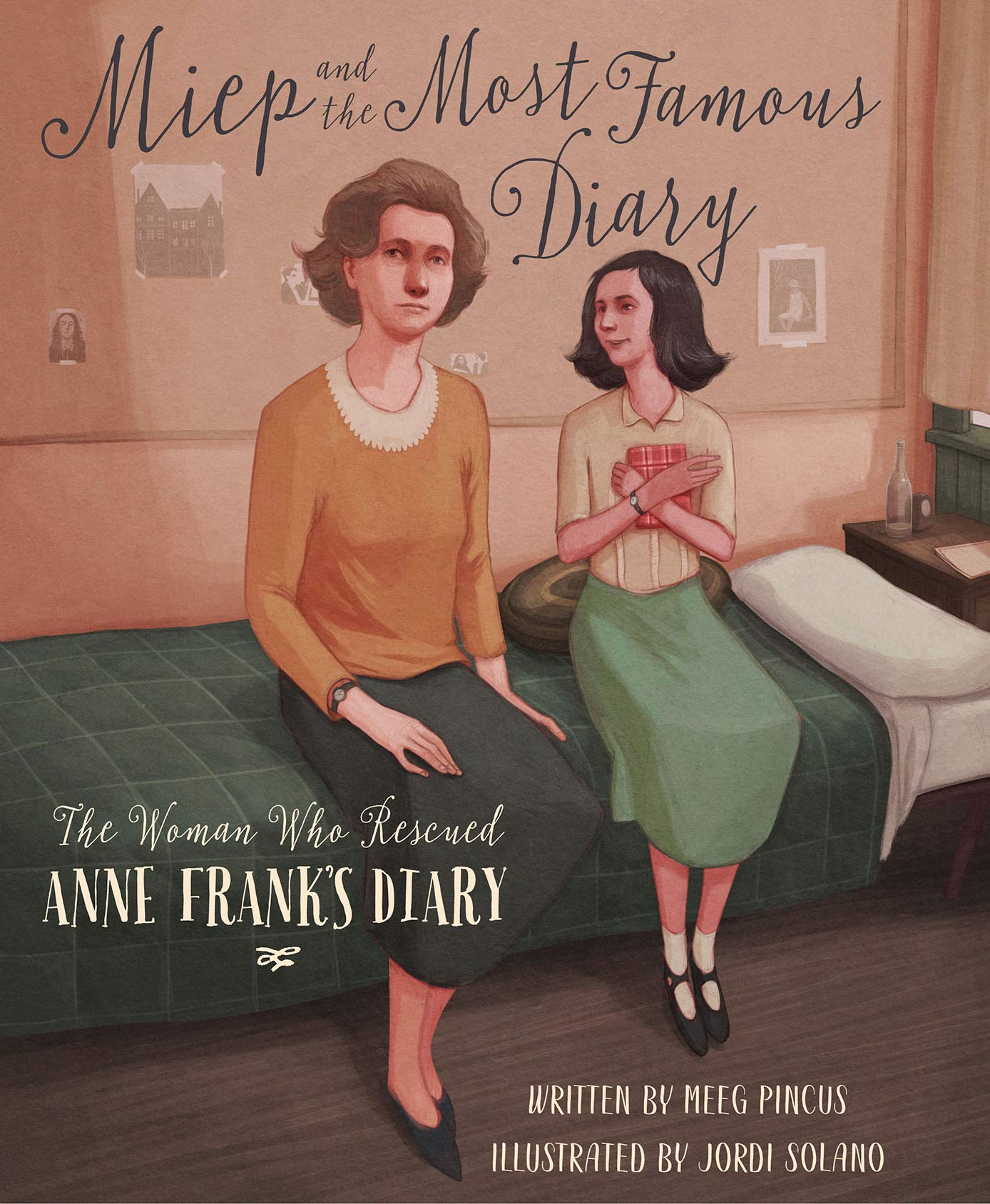
Miep and the Most Famous Diary: The Woman Who Rescued Anne Frank’s Diary by Meeg Pincus, illustrated by Jordi Solano

Published by Sleeping Bear Press

Image result for miep and the most famous diary

Image result for miep and the most famous diary

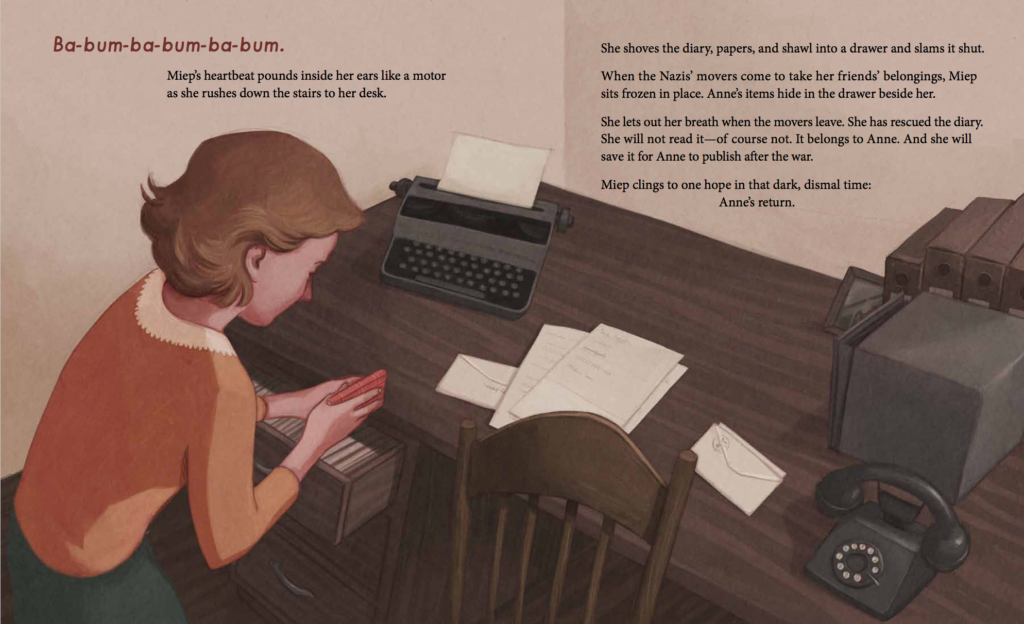
Summary:  Beginning on August 4, 1944, when the eight occupants of the Secret Annex under Miep Gies’s care were arrested and taken away, the narrative follows Miep’s story of how she saved Anne Frank’s diary.  Facing arrest for keeping any of the group’s belongings from the Nazis, Miep snuck back into the annex before their return, taking Anne’s diary and a combing shawl with some of Anne’s hair still on it. She kept these, hoping that Anne would return one day to claim them, but it was only Anne’s father, Otto Frank, who survived.  After he received the devastating news of his daughters’ deaths, Miep gave him Anne’s things. Even after the diary was published, it was many years before Miep could bring herself to read it. Reading it in one sitting at last, she felt a measure of peace, knowing that Anne would live on, thanks to her efforts. Includes an author’s note and a timeline of Miep’s life.  40 pages; grades 2-6.   

Pros:  Even with so many books about Anne Frank, this one is unique for its perspective from Miep’s point of view.  Her courage in standing up to the Nazis on numerous occasions is inspiring, as is her role in preserving Anne’s words.

Cons:  The illustrations were just okay.

If you would like to buy this book on Amazon, click here.

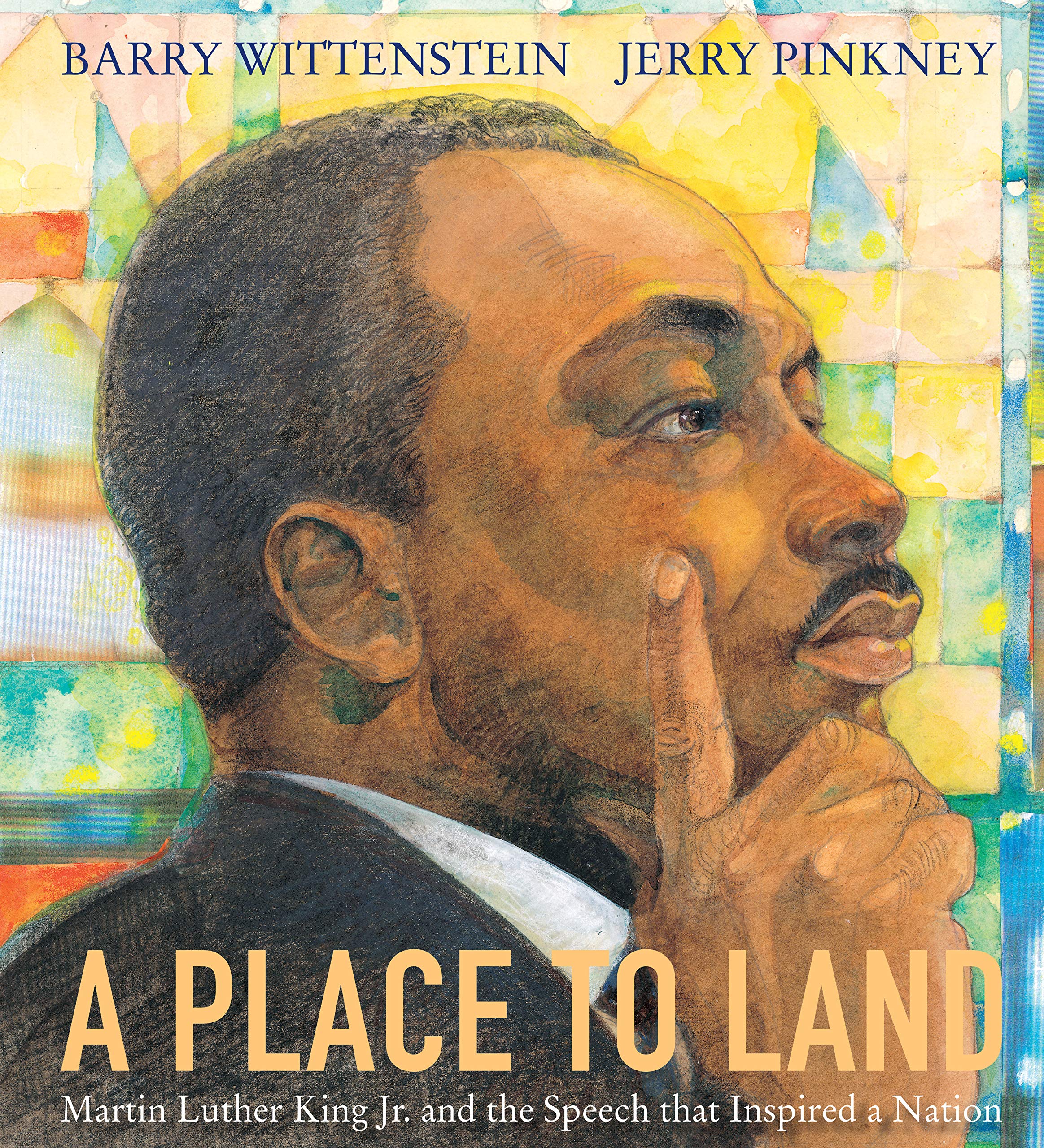
A Place to Land: Martin Luther King Jr. and the Speech That Inspired a Nation by Barry Wittenstein, illustrated by Jerry Pinkney

Published by Neal Porter Books

Image result for place to land martin

Summary:  Martin Luther King Jr.’s “I Have a Dream” speech is such an integral part of American history, it’s difficult to believe that it almost didn’t happen.  This book starts the night before the speech, when King sat down with his closest advisors to hash out what he was going to say the next day.  The focus was on jobs and economic justice, and one friend even advised, “Don’t use the line about ‘I have a dream.’ You have used it too many times already.”  King then retired to his room to meditate and pray about what he was going to say. Shortly after 3:00 the next afternoon, he delivered his speech. It went well, but didn’t seem quite powerful enough to him.  So when singer Mahalia Jackson called to him, “Tell them about the dream, Martin!”, he put his notes aside and spoke from his heart. Back at the hotel, he and his friends celebrated the speech, knowing that it was just the beginning of a long struggle ahead. Includes notes from the author and artist; thumbnail sketches of who was in the hotel that night; a list of who spoke at the March on Washington; and a bibliography.  48 pages; grades 2-6.

Pros:  So many picture books have been written about Martin Luther King, Jr. and “I Have a Dream”, but this one adds to the narrative, giving background to the speech and placing it in the context of the Civil Rights Movement.  Jerry Pinkney’s illustrations not only add beauty and color to the story, but label the different people that were there and who inspired King while writing his speech.

Cons:  There’s no additional information about some of the people labeled in the illustrations.

If you would like to buy this book on Amazon, click here.

Bringing Down A President: The Watergate Scandal by Dr. Andrea Balis and Elizabeth Levy, illustrated by Tim Foley

Published by Roaring Brook Press

Image result for bringing down a president amazon

Summary:  From the break-in at the Watergate hotel on May 25, 1972 to Richard Nixon’s resignation as U.S. President on August 9, 1974, this book covers what went on in the White House in a unique fashion.  The story is narrated by a “fly on the wall”, whose story is interspersed with quotes from many different key players in the events. There are black and white illustrations, some with cartoon bubbles that quote the people shown.  The epilogue tells what happened to those who went to jail (answer: all served ridiculously short terms and made obscene amounts of money off of their experiences when they got out), and those who put them in prison by persisting in their investigation.  Includes almost 200 sources and a three-page bibliography with a tiny font. 240 pages; grades 5-8.

Pros:  Even though I’ve watched All the President’s Men about ten times, this added a lot to my understanding of Watergate and the depths of the corruption going on in Richard Nixon’s presidency.  Once I got through the first few chapters and figured out who was who (there are a lot of characters, and they’re almost all white men in suits), I couldn’t put it down.  Anyone from tween to adult will add to their knowledge of history pretty painlessly by reading this book.

Cons:  1. The illustrations are fun, but photos would have been a nice addition. Those who went to jail are pictured at the end, but there’s not a single photo of Nixon. 2. As one might expect from a book featuring Tricky Dick, there is plenty of salty language, either quoted directly or through #?!&* indicators.

If you would like to buy this book on Amazon, click here.

Liberty Arrives! How America’s Grandest Statue Found Her Home by Robert Byrd

Published by Dial Books

Image result for liberty arrives byrd

Image result for liberty arrives byrd

Summary:  The idea for the Statue of Liberty began in France in 1865 when Édouard de Laboulaye, a wealthy French judge who admired America, dreamed of presenting the United States with a gift for the 1876 centennial.  He enlisted sculptor Frédéric-Auguste Bartholdi who specialized in large creations. Little did the two of them realize it would take more than two decades before their dream would finally come to fruition–and Laboulaye wouldn’t live to see it.  Part of the reason for the slowdown was the logistics of constructing a 151-foot statue and shipping it to the U.S.; the other part was money for covering the cost of creating the statue, shipping it, and building the base for her to stand on. Joseph Pulitzer finally solved the problem by challenging Americans to donate through his newspaper, the World, and approximately 121,000 people sent in $102,000.  On October 28 , 1886, Liberty Enlightening the World–more commonly known as the Statue of Liberty–was dedicated in New York Harbor.  Includes a diagram showing measurements of different parts of the statue; a timeline; a bibliography of books for adults and children and online sources; and Emma Lazarus’s poem printed on both endpapers.  40 pages; grades 2-6.

Pros:  This oversized book offers a wealth of fascinating, engagingly written information about the origins of the Statue of Liberty, all illustrated with Robert Byrd’s detailed watercolors.  Fun for browsing, and plenty of facts for research.

Cons:  The small, dense text may be a bit off-putting to kids.

If you would like to buy this book on Amazon, click here.

When Aidan Became a Brother by Kyle Lukoff, illustrated by Kaylani Juanita and It Feels Good to Be Yourself: A Book About Gender Identity by Theresa Thorn, illustrated by Noah Grigni

Published by Lee and Low Books

Image result for when aidan became a brother

Image result for when aidan became a brother


Published by Henry Holt and Co.

Image result for it feels good to be yourself amazon

Image result for it feels good to be yourself noah

Summary:  Aidan is concerned about the new baby that’s coming to his house.  Suppose his parents don’t recognize the new baby’s correct gender? That’s what happened to Aidan.  His parents thought he was a girl, and it took a few years to convince them that he was really a boy.  Finally, his mom reassures him: “We made some mistakes, but you helped us fix them. And you taught us how important it is to love someone for exactly who they are.  This baby is so lucky to have you, and so are we.” The gender of the baby is never revealed, but they are fortunate to have such a loving and accepting family. Families who may be struggling with acceptance could benefit from It Feels Good to Be Yourself, which defines the terms transgender, cisgender, and non-binary, giving examples of kids who describe themselves in each of these ways.  The conclusion here: “Your feelings about your gender are real. Listen to your heart. No matter what your gender identity is, you are okay exactly the way you are.”  32 pages (Aidan) and 40 pages; ages 4-8.

Pros:  Love and acceptance is good for everyone, and these two books help create more of it for kids and families who may be working through issues of gender identity.  

Cons:  There’s a certain free-to-be-you-and-me earnestness, particularly with It Feels Good to Be Yourself, which may feel dated when different gender identities become more a part of the culture.

If you would like to buy When Aidan Became a Brother, click here.

If you would like to buy It Feels Good to Be Yourself, click here.